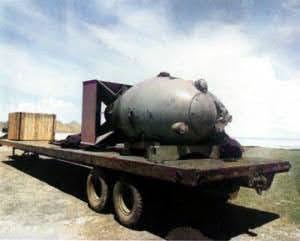
The official designation was the “10,000-pound L.C. (Light Case) bomb.” U.S. personnel called it the “pumpkin bomb” because its rounded shape and yellow paint resembled a pumpkin. That shape was related to the implosion-lens mechanism of the Nagasaki atomic bomb. Because the shape could reveal clues to that mechanism, it was important that the simulated bombs detonate reliably and leave no evidence.
The simulated atomic bombs are said to have served several purposes:
(1) Practicing the drop: aiming at a target from about 9,000 meters, then making a sharp turn and flying away to escape the blast.
(2) Raising crew morale by bombing actual targets on the Japanese mainland.
(3) Familiarizing crews with the geography around the proposed atomic bombing targets.
(4) Accustoming people in Japan to attacks in which a single B-29 arrived and dropped one bomb.
(5) Assessing the simulated atomic bomb’s effectiveness as a weapon in its own right.
These attacks were more than practice for dropping an atomic bomb. Training drops had already taken place in the United States and near the base on Tinian. The missions over Japan were bombing attacks intended to destroy military targets identified through U.S. reconnaissance. Those targets were in cities around the prospective atomic bombing targets of Niigata, Kyoto, Hiroshima, Kokura and Nagasaki.
The historical importance of the simulated bombs lies in the fact that the atomic bombings and the simulated atomic bombings were treated as a single series of Special Bombing Missions (SBM). Atomic bombing reports and operational orders describe the atomic attacks as individual operations within that series. Most members of the 509th Composite Group did not know that their unit’s purpose was to deliver atomic bombs until shortly before Hiroshima, and they did not know about the development of the atomic bomb. From the crews’ perspective, both types of mission followed the same pattern: fly thousands of kilometers from Tinian, drop one large bomb on a target in Japan from about 9,000 meters, make a sharp evasive turn, and fly thousands of kilometers back.
The simulated atomic bomb was approximately 3.3 meters long and 1.5 meters in diameter, and weighed about 4.8 metric tons. Like the atomic bomb, it could only be carried singly by a specially modified B-29. It contained nearly 2.9 metric tons of explosive. Richard Campbell’s The Silverplate Bombers gives a total weight of 10,525 pounds and an explosive charge of 6,300 pounds. By comparison, a powerful one-ton bomb used in the Pacific War contained 429 kilograms of explosive. On the basis of explosive weight alone, a pumpkin bomb had almost seven times that destructive potential. Apart from atomic bombs and earth-penetrating bombs, it could be described as one of the largest weapons of mass destruction used in the Second World War. It was an exceptional weapon in its own right.
Using pumpkin bombs as regular conventional weapons was also considered. The bombing of Aichi Prefecture on August 14 is said to have served partly as a test of that possibility. Ultimately, their effectiveness apparently did not justify their production cost, and unused bombs were dumped at sea.
A Google My Maps map marking simulated atomic bomb impact sites whose coordinates are known:
https://www.google.com/maps/d/u/0/edit?mid=1hA0DPcydVebEZOkLERnTbbbSFSbfJMoe&usp=sharing
Wikipedia article on pumpkin bombs (Japanese):
https://ja.wikipedia.org/wiki/パンプキン爆弾
The image of the pumpkin bomb from Wikipedia was automatically colorized with the smartphone app Colorize. The actual bomb casing was yellow.
Select the image to view it in a new tab.