According to U.S. military records, the simulated atomic bomb was dropped at 7:55 a.m. on July 20, 1945, from an altitude of 29,000 feet (8,839.2 meters). The target was central Otsu, at 36°50′N, 140°47′E. The target was identified by radar rather than visually, apparently because of cloud cover.
The original target was a factory in Koriyama. Because the sky over Koriyama was also cloudy, the crew chose a town center as a secondary target. That town was Otsu.
Why Otsu was selected is unknown. However, the flight route in the operational order specified a point off Otsu, at 36°49′N, 140°48′E, as the place where the aircraft would reach the Pacific on the return journey from Koriyama. The area was therefore already on the route of the three B-29s assigned to attack Koriyama.
The original factory target was the Koriyama plant of Nippon Seiren, which produced phosphorus products at the time. It is thought to correspond to the present Fukushima No. 1 plant of Nippon Chemical Industrial Co., Ltd.
Late on July 19, many B-29s attacked Hitachi with incendiary bombs. Some of those aircraft continued north, and Juo (now part of Hitachi), Takahagi and finally Isohara were also attacked. In the Isohara air raid, incendiaries fell west of Isohara Station, destroying nearly 100 homes and killing two people. The simulated atomic bomb was dropped the following morning. “The morning after the Isohara air raid” is an important point of reference when recalling these events.
The U.S. aircraft routes in the Otsu air raid of April 12, 1945, and the simulated atomic bombing of July 20 were similar. The Otsu raid is said to have been carried out by a P-51 returning from escorting B-29s that had attacked Koriyama. One P-51 dropped six 50-kilogram bombs on central Otsu, causing fires and killing 49 people. Both attacks followed a Koriyama-to-Otsu route. This may simply have been a convenient route back from Koriyama to Iwo Jima.
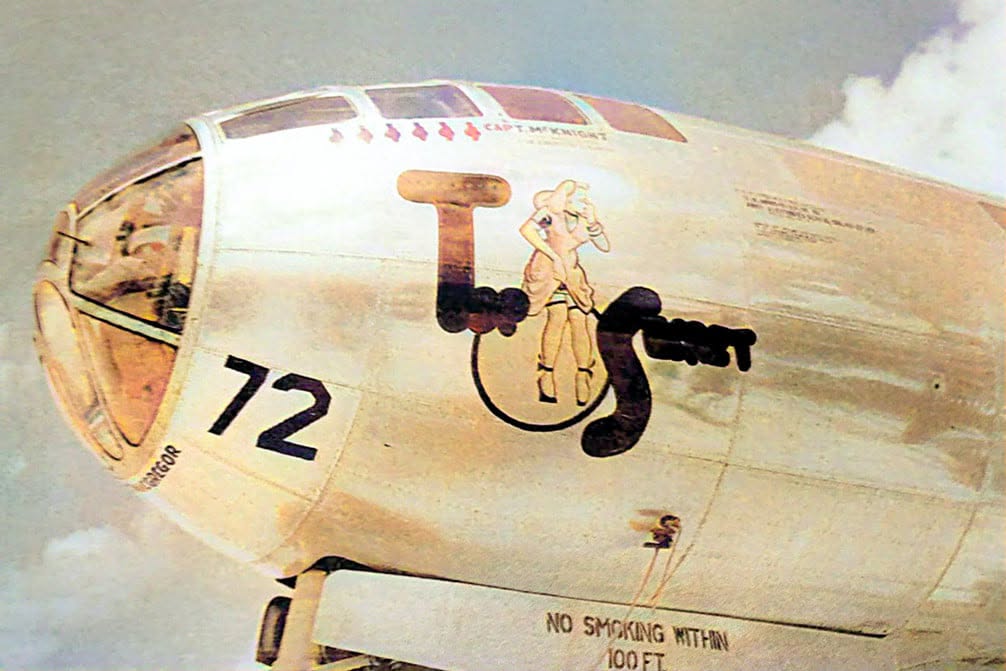
The Kitaibaraki bomb was dropped at 7:55 a.m. on July 20, 1945, at the same time as two pumpkin bombs dropped on Toyama. They can therefore be described as the first simulated atomic bombs dropped in Japan. This was also the first operation in the series of Special Bombing Missions that included Hiroshima and Nagasaki. The mission of Top Secret, the B-29 that bombed Kitaibaraki, was designated “a,” the first entry. This is why lists of the 52 simulated and atomic bombing locations often begin with Kitaibaraki. For many years, however, its impact site remained unknown. Identifying Kitaibaraki’s site would leave only three unidentified locations, apart from one bomb jettisoned at sea: Taira in Iwaki, near Uchigo, on July 20; Kobe on July 24; and Tokushima on August 8. As of July 2024, research by Nishioka (西岡孔貴) and others appeared to be bringing the location in Kobe closer to identification.
The photograph shows Top Secret, the B-29 that dropped the simulated atomic bomb on Kitaibaraki. A photograph in Richard Campbell’s The Silverplate Bombers was automatically colorized with the smartphone app Colorize. The aircraft was actually silver.
Select the image to view it in a new tab.